Real-time rendering is the process of generating 3D images instantly, allowing users to interactively navigate and modify scenes without waiting for render queues, unlike traditional offline rendering, which can take hours per frame.
It lets you move through, look around, and interact with a three-dimensional scene as it renders in real time in front of you. Advances in hardware and software have made it a practical part of everyday workflows in architecture and design.
Real-time rendering changes how architects, designers, and 3D artists work. It gives them the ability to move through a scene and make changes in real time, removing the waiting that once broke creative momentum. Potential errors surface earlier, iterations happen faster, and what would previously have required a queue of render jobs can now be explored in seconds.
The benefits extend beyond individual productivity. It opens up new possibilities for presentation and collaboration, shortening the feedback loop between architects, clients, and colleagues. Adjustments can be made on the fly during a meeting, design alternatives can be shown rather than described, and the gap between a design decision and a photorealistic result is now narrow enough that the creative process itself becomes more fluid and responsive.
Ray-traced real-time rendering enables interactive exploration of 3D content with photorealistic quality. It simulates the physical properties of light, making it possible to simulate many optical effects, including reflection and refraction, scattering, soft shadows, depth-of-field, motion blur, ambient occlusion, and indirect lighting.
Lightning-fast real-time rendering makes life easier for architects, designers, and 3D artists. They can easily explore scenes or models, and there's no more waiting for renders to complete, as hundreds of images or an animation can be generated instantly.
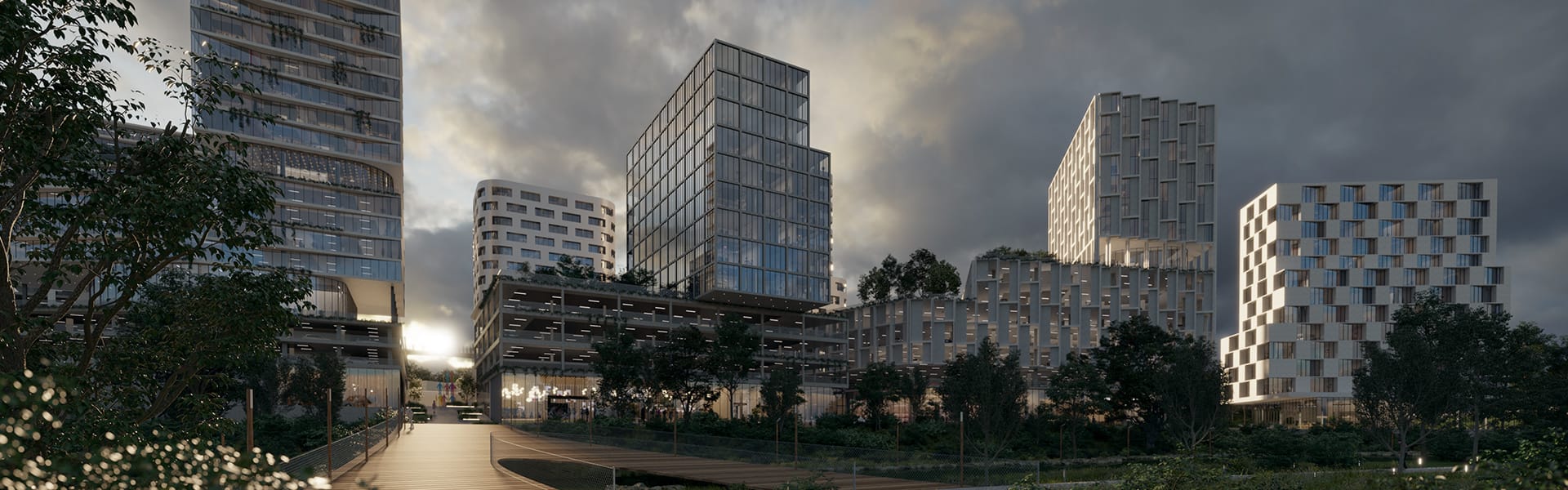
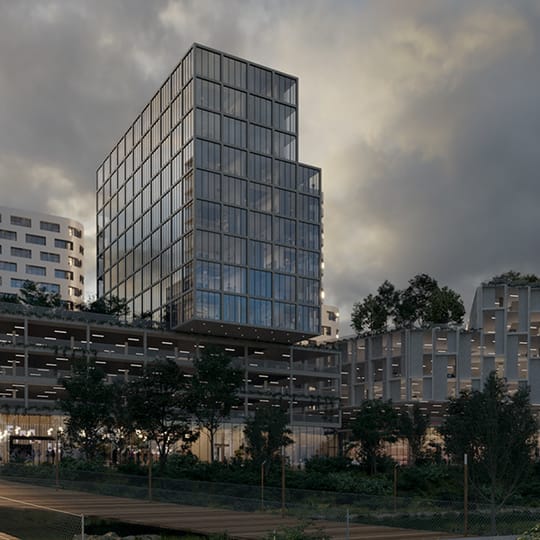
Real-time rendering software has made architectural rendering a tool for everyday workflows. Architectural rendering, also known as architectural visualization, involves creating 2D and 3D images and animations that showcase projects and demonstrate what a building will look like before it's built.
With speedier rendering times and tools designed for simplicity, design is no longer a slow and expensive process, but rather a fast and efficient one that helps architects validate ideas, engage in faster iterations, and act as a tool to communicate with clients.
Tools like Enscape give architects an edge with clients, as they can visualize a design and produce high-quality 3D renders in real-time. Enscape is ideal for any design workflow as it's easy to use. Compatible with Revit, Sketchup, Rhino, Archicad, and Vectorworks, it allows you to work directly from your architecture projects. With just one click, you can instantly transform your model into a building or landscape rendering.
Virtual reality (VR) is becoming more mainstream and widely adopted, especially in architecture and design. For architects and designers, VR and real-time rendering combined is a powerful tool for storytelling and interactivity; a client can step inside a model of a building that doesn't yet exist, experience its scale, light, and materiality firsthand, and respond to it in a way that no flat image or walkthrough video can match.
Enscape makes immersive experiences accessible directly from the design environment, turning a VR presentation into a natural extension of the everyday workflow rather than a separate production effort.
Real-time rendering software is used in various industries such as video games, film, and media. From blockbuster visual effects and animated films to video games and virtual production stages, it gives artists and studios the ability to create photorealistic environments, characters, and lighting at a scale and at unimaginable speed.
It's increasingly used in film and television pre-visualization, allowing directors and cinematographers to explore virtual sets in real time before a single physical element is built. This compresses timelines, reduces costs, and gives creative teams the freedom to experiment without consequence.
Vantage is a powerful, real‑time, GPU‑accelerated renderer designed for exploring, presenting, and manipulating V-Ray and Corona scenes within a 100% ray‑traced, interactive environment. It is compatible with all V-Ray and Corona integrations and
A knowledge base is essential for users of real-time rendering software. It provides resources and tutorials to help them get started and to learn and improve their skills. The Chaos Blog and official Chaos documentation are reliable resources for tips and to-dos for Enscape, Vantage, and other Chaos products.

Navigate and explore your project from every angle and follow every update instantly thanks to the bi-directional geometry exchange.

Connect a VR headset, such as the Meta Quest 3 or HTC Vive Pro 2, and walk or fly through your project for an immersive experience.

Boost walkthrough quality and capture exports with an advanced denoising solution powered by NVIDIA ReLAX denoiser.

Transfer key data from Enscape to V-Ray and other design applications, including 3ds Max and Cinema 4D, with .versce files.

Leverage AI to improve assets, specifically people and vegetation, without interruptions or performance loss to your workflow.

Use on Windows computers with Intel and AMD iGPUs, accessible to more than just computers with separate physical GPUs.
-min-1.avif)
Germany-based architectural firm Sonnentag Architektur produced designs for Mönchengladbach Medical Center using Enscape and Veras.
